
Starlink on an Ordinary Phone in Iran? What is real today
Let me give you the conclusion first. Direct to Cell is real. But the idea that today, in Iran, you can pick up your ordinary phone and connect straight to Starlink — no dish, no antenna, no extra equipment — and get online is not real. Not yet.
So when you see headlines like “Starlink internet straight to your phone in Iran” or “no more need for a dish”, selling this as a practical answer for people inside Iran, you are looking at a sales pitch for a dream, not a service you can use.
I wrote this with the help of AI, but from technical documentation, academic measurement studies and the published material of the operators and providers involved.

0public services
Starlink has announced for users inside Iran — as of October 2026
Status as of 4 October 2026. This field moves fast; dates are given with every figure.
In five lines
What is true today
- 01Direct to Cell is real and commercially live in several countries, through partner mobile operators.
- 02No public Direct to Cell service has been announced for users inside Iran, and nothing official says one exists.
- 03One beam's estimated capacity, about 3 Mbps outdoors, is shared by everyone under it. That works for a stranded driver; it cannot carry a city whose internet has been cut.
- 04A phone's signal reaching the satellite is weak and goes in every direction, which leaves it more exposed to jamming than a Starlink dish.
- 05The next generation promises far more capacity from 2027. It is not in orbit yet, and today's network should not be credited with what it might do.
The idea
What is Direct to Cell, anyway?
The idea sounds simple. Instead of your phone always having to reach a mobile mast on the ground, a satellite in low Earth orbit plays part of the role of that mobile base station.
In today's Starlink Direct to Cell, the aim is that compatible phones can reach a satellite through ordinary cellular standards — without a Starlink dish and without a special satellite antenna. Unlike ordinary Starlink, there is nothing to put on the roof. That part is completely real.
The technology existing does not mean it is available in every country.
What the viral videos leave out is how the current generation is built: on partnerships with mobile operators. The partner operator lends part of its radio spectrum, and the satellite network plugs into the operator's own infrastructure. In plain words, a satellite is not enough. Spectrum, an operator, a core network, regulatory permission and a stack of technical and legal coordination are all part of it.
This architecture will not stay the same forever. For the next generation, SpaceX is moving towards dedicated satellite spectrum and 5G NR-NTN, so “Direct to Cell will always need a domestic operator in each country” is not accurate either. But for the generation actually in use today, operator partnership is still central.
The map
Where it is switched on
The satellites pass over every country on Earth, Iran included. The service does not. It is switched on one country at a time, through a local operator.
Drag to turn the globe.
Iran is under the same satellites as everyone else — and has no partner operator, no spectrum agreement and no regulatory approval. The satellites are there; the service is not.
- United StatesT-Mobile
- CanadaRogers
- New ZealandOne NZ
- AustraliaTelstra
- JapanKDDI · Docomo · SoftBank
- PhilippinesGlobe
- ChileEntel
- PeruEntel
- Costa RicaLiberty
- PanamaLiberty
- KazakhstanBeeline
- UkraineKyivstar
- United KingdomVirgin Media O2
- DR CongoAirtel
- UgandaAirtel
Today
So what can it actually do now?
Direct to Cell is no longer a lab experiment. In several countries it has gone operational with mobile operators, offering messaging and some data services.
But it should not be confused with the high-speed Starlink internet we get through a dish. What it carries today is text messages, a set of selected apps and voice through apps such as WhatsApp — there is no ordinary phone calling over it yet. The main goal of the current generation is closer to this: where the mobile network ends, some connection survives. For example:
SpaceX's figures in its 2026 prospectus, as of 31 March 2026. The satellites orbit at about 360 km.
- Remote roads
- Rural areas
- Mountains
- Network blind spots
- Emergencies
That is why the accurate term for what it is today is something like supplemental coverage — not a replacement for the mobile network.
Iran
So what is the situation in Iran?
As of early October 2026, Starlink has announced no public Direct to Cell service for users inside Iran. There is no credible official announcement showing that Iranian users can connect directly to Starlink today with their ordinary phone and SIM.
One point matters here. Technically, the only possible scenario is not necessarily that Hamrah-e Aval or Irancell sign a contract with Starlink. In theory, scenarios involving a foreign operator, roaming or a foreign SIM/eSIM can be examined. But there is a long distance between these two:
An engineer can imagine a scenario
The service is usable by people in Iran today
And for now, there is no evidence for the second.
Washington
The United States has looked at this too
In June 2026 a report, based on information attributed to Reuters, said the Pentagon had discussed with SpaceX the possibility of using Direct to Cell for Iranian citizens. According to the same report, figures of around $500 million to set it up and around $100 million a month were mentioned.
The underlying Reuters report was published on 26 May 2026. The Pentagon called its claims “not based in reality” and Elon Musk called it “false”; Reuters said it could not confirm whether any agreement was reached.
But the problem is not only money. Even setting the political, legal and financial questions aside, there is another large one: capacity.
The switches
What has to be true before it works in a country
Kazakhstan's launch shows what it takes. Pick a country and see which switches are on.
- Satellites overheadStarlink's Direct to Cell satellites pass over the whole planet.
- Compatible phonesMost recent LTE phones can work; no special hardware is needed.
- A partner operatorA mobile operator whose network the satellite service plugs into.
- SpectrumRadio frequencies the operator makes available to the satellite network.
- Regulatory approvalThe national regulator has to permit the service.
- Core network linkIntegration with the operator's core network, so phones are recognised and billed.
The satellites and the phones are there. Every switch that depends on agreements is off.
Capacity
Why today's Direct to Cell cannot replace urban internet in Iran
This is where the important part of the story begins. Your phone was not designed to talk to a satellite. An ordinary phone transmits at very limited power — at most about 0.2 watts — and now this same device has to reach a satellite about 360 kilometres above the Earth, moving at more than seven kilometres a second. That is a real engineering achievement.
But physics cannot be removed by advertising. Academic measurements of the Direct to Cell network show the received signal can be markedly weaker than terrestrial LTE.
Physics cannot be removed by advertising.
About 24 decibels apart — roughly 251 times less power arriving. To make up for it the satellite uses large antennas, beamforming and advanced processing. But there is another fundamental limit.
Try it
One beam, one city
A satellite cannot build an unlimited private channel for every phone. Radio resources are shared among everyone in an area — and one beam's footprint is tens of kilometres across, wider than a whole city. One academic study estimated about 3 Mbps per beam outdoors; that is not one user's capacity, it is shared. Pick a city and decide how many people go online at once.
- A text message≈ 100 bps
- Messenger chat≈ 2.0 kbps
- A voice call≈ 24 kbps
- Sending a photo≈ 50 kbps
- Loading a web page≈ 500 kbps
- Watching video≈ 1.5 Mbps
A deliberately simple model: shared capacity divided evenly, ignoring signalling overhead, retransmissions and how the system schedules users. The real figures would be lower, not higher. The bitrates per use are rough orders of magnitude.
- A driver on a remote road who wants to send a message? Great.
- A few people lost in the mountains? Very valuable.
- A village outside coverage that needs emergency contact? A remarkable use.
But millions of people in Tehran, Mashhad, Shiraz, Isfahan and Tabriz whose terrestrial internet has been cut, all wanting at once to watch video, make calls and open Telegram and Instagram? That is a completely different problem. The current generation was not built for that load.
The uplink
The next problem: from your phone to the satellite
In satellite links, one of the hardest parts is the path from phone to satellite. The satellite has a large antenna and powerful equipment. Your phone does not: it is a small device with a limited battery and an antenna designed to talk to masts on the ground.
That is why a clear view of the sky matters so much. Inside a building, a car park, a basement, under a heavy roof or between tall buildings, conditions can get much worse. Direct to Cell should not be compared with ordinary LTE, where a phone indoors talks to a mast a few hundred metres or a few kilometres away.
Jamming
Then we come to jamming
This part matters a great deal for Iran. The Direct to Cell signal is inherently weak, especially from the phone up to the satellite, so deliberate interference on the ground can be a serious problem. A Starlink dish is a directional, specialised antenna — and even dishes were hit: in January 2026, Filterwatch measured packet loss of 10 to 40 percent on Starlink connections, mostly in Tehran. A phone has no such advantage.
A schematic, not a measurement: it shows the geometry of the problem, not the outcome of any particular jammer.
But we should watch for a different exaggeration here too: saying “so the government can definitely knock Direct to Cell out completely” is not a proven claim either. The accurate conclusion: jamming is a real and serious technical threat, and any analysis of using this technology in Iran has to account for it.
The protocol
And a stranger problem: LTE itself
One of the most attractive things about Direct to Cell is exactly that an ordinary phone does not have to become a satellite phone. But that same advantage creates a limit. LTE was designed for phones talking to masts that stand on the ground — not to a base station moving at several kilometres per second in orbit.
The satellite keeps moving, the distance keeps changing, there is Doppler shift and changing latency, and the satellite a phone is using has to keep handing over to another — while the phone must still believe it is dealing with an ordinary cellular network. Measurement studies published by the ACM have observed problems like these:
- 01Frequent access failuresAttempts to connect to the satellite that do not succeed.
- 02Ping-pong handoversThe connection bouncing back and forth between satellites.
- 03Extensive retransmissionsThe same data sent again and again before it gets through.
More interesting still, the researchers concluded that some of these problems do not disappear simply by launching more satellites or adding spectrum. Part of the problem comes from keeping the system compatible with existing networks and phones.
Engineers are stretching a protocol built for the ground up into low Earth orbit. And nature, as usual, has no interest in corporate PowerPoint.
The next generation
What happens next?
This is where the story gets much more interesting. SpaceX has a far bigger plan for the second generation: bigger antennas, more spectrum and newer technology, moving towards 5G and standards better suited to non-terrestrial networks (NTN).
Logarithmic scale. Hatched: announced, not yet in orbit.
The 20× and 100× figures are from SpaceX's announcement of its spectrum deal with EchoStar in September 2025; its 2026 prospectus says “orders of magnitude”. Second-generation satellites are to start launching on Starship in 2027, the spectrum deal is not expected to close until November 2027, and full 5G-NTN service needs phones with new radio hardware. If these targets are met, what is today a supplementary network for blind spots could become something far more serious. But two words matter: “if” and “future”.
The nearest example
Kazakhstan is a good example
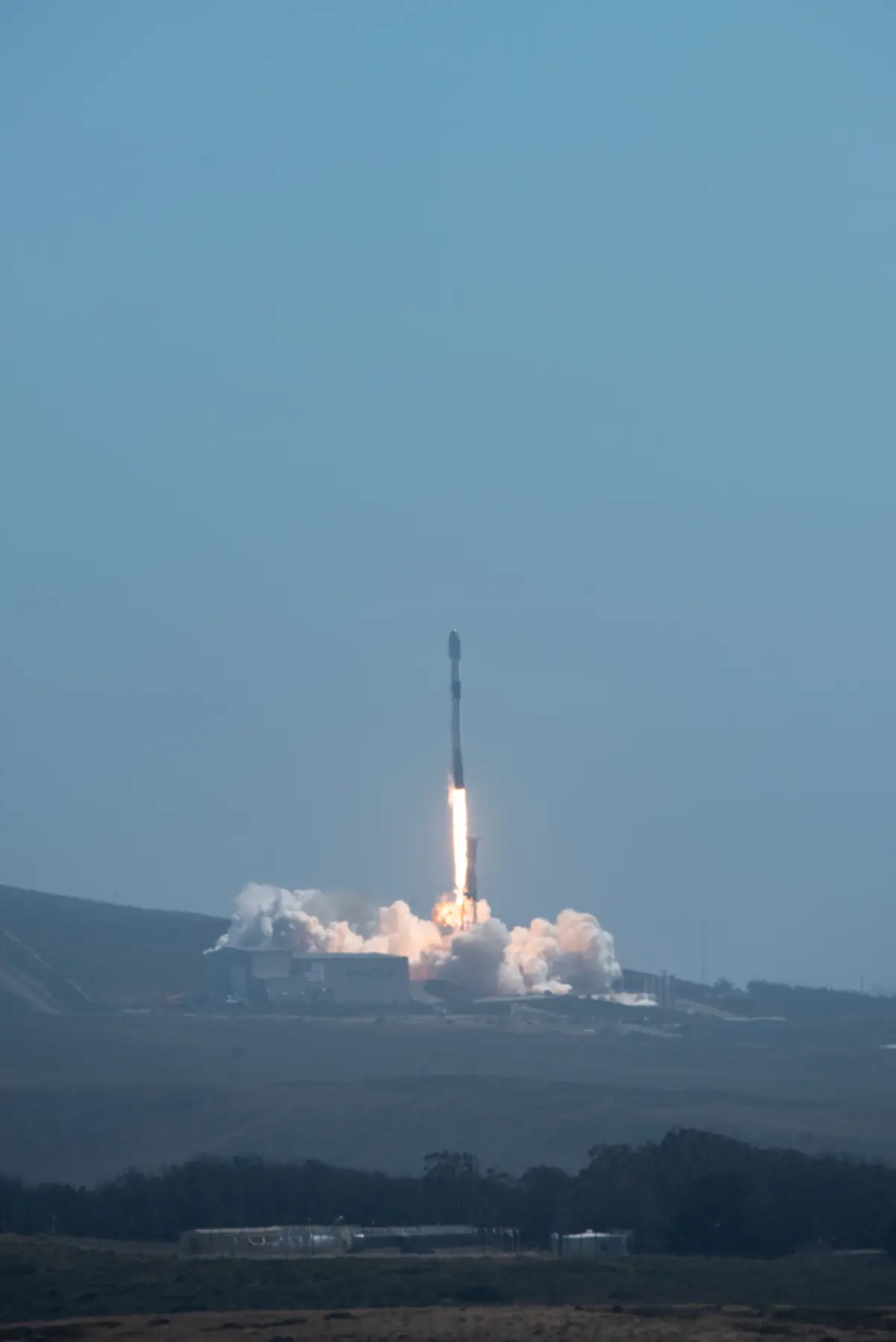
Kazakhstan is in fact a very good case for understanding all this. At the end of September 2026, the partnership between Beeline Kazakhstan and Starlink went operational, and Direct to Cell service was offered for places outside the terrestrial network: messages and a set of apps, free for a promotional period, and for now on compatible Android phones only. It came after a first test call — a WhatsApp audio call — in December 2025.
- First: the technology is real.
- Second: switching it on is the result of cooperation between Starlink, an operator, spectrum, infrastructure and a regulatory framework.
Nobody at SpaceX presses a button on a map so that the next morning every phone in a country is connected to a satellite.
Let's sum up
Seven questions, straight answers
The point
So when you see a video of someone in a remote part of the United States, New Zealand or Kazakhstan holding up their phone and sending a message through Starlink, do not conclude: “so satellite internet without a dish has been switched on in Iran too.” Those are not the same statement.
Direct to Cell is in fact one of the most important changes coming to the telecom industry, and will probably blur much of the line between “mobile network” and “satellite network” over the next few years. But precisely because it is important, there is no need to exaggerate it.
We are watching the start of a big change in telecommunications. But we have not reached the point where millions of people in Iran, during an internet shutdown, take their ordinary phone out of their pocket, choose Starlink and come back online.
Not yet, at least.
Method and sources
How this was put together
- Status as of 4 October 2026. Partner operators and service details change often; each is dated and sourced.
- Capacity and signal figures come from an academic field study of the first-generation network in the US (IEEE Communications Magazine, June 2026). They describe that network, not the announced second generation.
- The city calculator is a deliberately simple model. Real per-user speeds would be lower, not higher, once signalling, retransmissions and scheduling are counted.
- The figures for the Pentagon talks are reported, attributed to Reuters, and were disputed by the Pentagon and by Elon Musk.
- On the globe, “live” means public commercial service confirmed by an operator or trade source; every other partner on Starlink's official list is shown as announced, even where it may already have launched.
- The globe's satellites are illustrative, not a live ephemeris.
- Written with the help of AI, from the documents and studies listed here. This is analysis, not advice on using any service.
Sources
- Starlink — Starlink Mobile (Direct to Cell): partners and service
- SpaceX — Direct to Cell first text update, January 2024 (operator LTE spectrum; roaming-partner integration; 0.2 W phone power)
- Starlink — 2025 Progress Report
- SpaceX — Form S-1 registration statement, 2026 (figures as of 31 March 2026)
- Starlink — Constellation altitudes (V1 Direct to Cell shells at ~360 km)
- Garcia-Cabeza J et al. — Direct-to-Cell: A first look into Starlink's direct satellite-to-device RAN through crowdsourced measurements. IEEE Communications Magazine 64(6), June 2026
- Liu W et al. — A variegated look at Direct-to-Cell satellites in the wild. Proc. ACM Meas. Anal. Comput. Syst. 10(1), 2026
- EchoStar — Spectrum agreement with SpaceX, 8 September 2025
- Ookla via ISPreview — The size of Starlink's Direct to Cell beams, 19 August 2026
- Iran International — Direct-to-cell offers Iranians future hope, not a fix today, 27 June 2026
- Reuters via CNBC — Pentagon spars with SpaceX over Starlink price hike during Iran war, 26 May 2026
- ABC News — Pentagon denies claims of SpaceX clash, 27 May 2026
- Filterwatch — Network monitoring, January 2026 (Starlink packet loss in Tehran)
- Via Satellite — Kazakhstan population gets access to Starlink connectivity through Beeline, 28 September 2026
- PR Newswire — Starlink satellite-to-mobile service launched in Kazakhstan, 1 October 2026
- Via Satellite — Beeline Kazakhstan completes Direct to Cell call with Starlink, 15 December 2025
- Via Satellite — Verizon, AT&T and T-Mobile formally establish a joint venture for D2D services, 2 October 2026
- T-Mobile — T-Satellite service and compatible phones
- Statistical Centre of Iran — 2016 census (city populations, via Wikipedia)