
Trust You Can Check What still earns trust
Asked how their trust in ten institutions has changed, every generation in every country reports a net decline, and people report the steepest falls for politicians and government. What holds up is trust people can check for themselves: their own doctor, their friends and family. The report's explanation is the end of a shared national broadcast culture, and it is candid that this is still an explanation, not a finding.
Read and drawn by Farjad · Source: Electric Twin, with Prof. Michael Muthukrishna
Company survey report · not peer-reviewed · publisher sells synthetic audiences
- trust their own doctor a lot or completely
- 87%
- The most trusted of 15 sources the survey asked about.
- trust friends and family a lot or completely
- 83%
- Second of 15. Both are sources people can check.
- platforms Gen Z use each week, of 21
- 6.2
- Boomers: 3.0. Twice as many feeds.
- of the bundling gap that everything measured explains
- A fifth
- Wave 2. Four fifths remain unexplained.
What this is, and what it is not
A reading of one survey report: Electric Twin's “Gen Z is Unbound” (October 2026), 51,929 online-panel survey responses from the US, UK, France and Germany, collected in two waves between January and April 2026. Electric Twin is a London company that sells AI-simulated (“synthetic”) audiences, and the report's academic co-author is listed by the company as its science advisor. It is not peer-reviewed, and it is one snapshot in time, so it cannot tell a generation apart from an age. The figures are the report's; the reading and the charts are mine.
Four figures below are interactive. Each one you try adds a badge to the series case, bottom corner.
01 · The ledger
What happened to trust
People were asked how their trust in each institution has changed, from −2 (much less) to +2 (much more). Every generation in every country reports a net decline.
- Gen Z
- Boomers
- Medicine+0.20+0.13
- Academia+0.11−0.25
- Tech−0.01−0.25
- Banks−0.08−0.19
- Schools−0.12−0.34
- News media−0.17−0.37
- Police−0.28−0.25
- Religious institutions−0.17−0.39
- Government−0.50−0.90
- Politicians−0.54−1.03
The largest reported falls are for politicians and government, and among Boomers and Gen X. Gen Z report the smallest. The report says very few people trust politicians completely: between 1% and 7%, depending on generation.
Medicine is the only one of the ten institutions where people report trust rising, slightly, in every generation. On our reading of the chart, only Gen Z report rising trust in academia.
A memory of decline, not a measured one
These are people's own accounts of how their trust has changed. The report says that over the two months between its waves, measured trust did not fall. What people describe is a loss of confidence that built up over years, and recollections of change are a weaker kind of evidence than repeated measurement.
02 · What holds
Trust people can check
Asked to pick the main reason they trust institutions less, the generations largely agree.
87%
Trust their own doctor a lot or completely
83%
Trust friends and family a lot or completely
- ≈3 in 10say institutions care only about money or power
- ≈3 in 10say institutions aren't honest with the public
- 21%of Boomers add that institutions take political sides, more than younger people
Your own doctor is the most trusted of the 15 sources the survey asked about (a separate list from the ten institutions above); friends and family come second. Doctors and medicine are also the one institution where people in every generation report trust rising.
Those are the failings people would notice once they can see and compare what institutions do for themselves. Trust that rests on what people can see for themselves is holding up; trust that rested on being people's main source of information is not.
03 · Why?
The broadcast account
So much for what the survey found. Why it is happening is harder to show. The report's most natural explanation runs through how information travels.
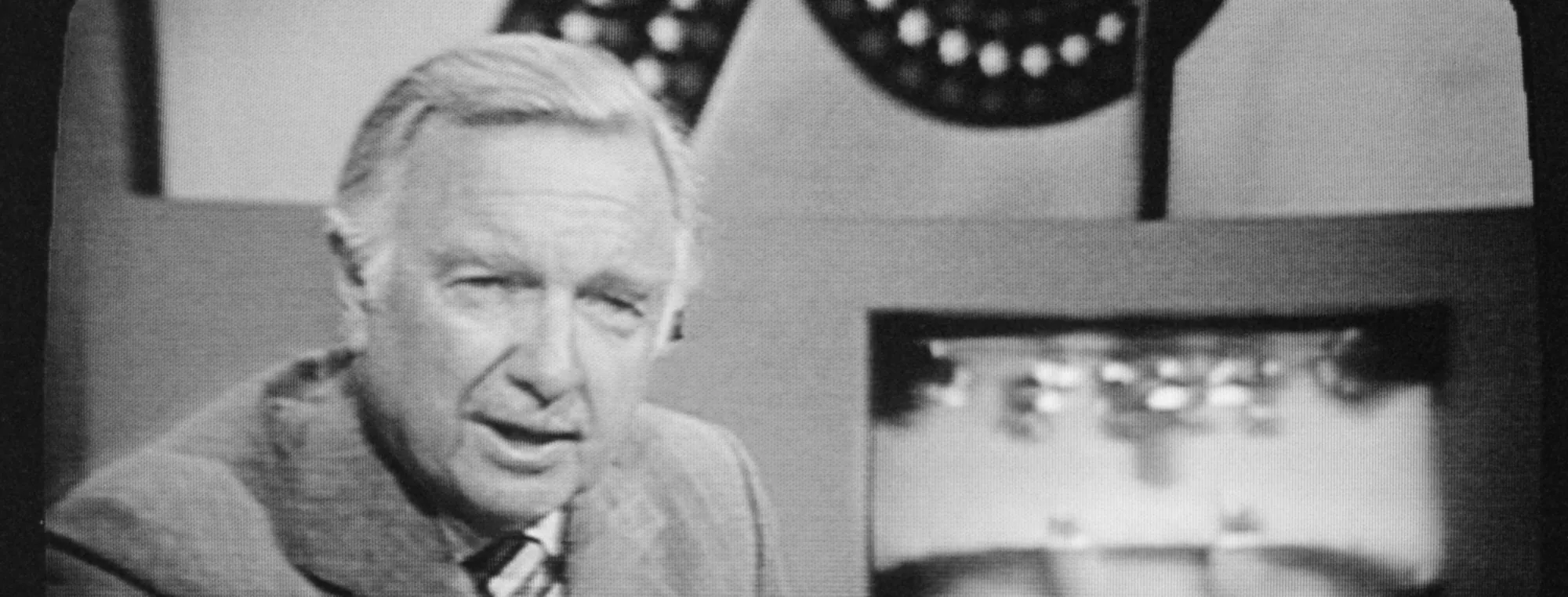
For six or seven decades, from network television in the 1950s to the algorithmic feed in the 2010s, culture flowed through a handful of national channels. The report's image for that era is Walter Cronkite, the CBS anchor often called “the most trusted man in America”, a label from a 1972 poll that CBS then used in its advertising. Mass media created common knowledge at the scale of nations, institutions built their authority on it, and political positions travelled as national packages because the channels that carried them were national.
On this account, the internet broke that. If culture now reaches the young through feeds that cross borders and are cut for each person, you would expect what parts 1 and 2 of this series found: national differences shrinking, and the packages that bundled positions together coming loose.
Where each generation spends its week
- Gen Z
- Boomers
- YouTube83%55%
- Instagram78%30%
- TikTok72%15%
- WhatsApp62%56%
- Snapchat61%6%
- Facebook46%69%
Gen Z use 6.2 of 21 platforms weekly on average; Boomers 3.0.
Facebook is the only one of the six that Boomers use more.
The report says about a third (33%) of “highly online” Gen Z, a subgroup it does not define, say algorithms shape their interests, beliefs or identity a lot.
04 · Honest limits
Where the data stop
How much of the broadcast account can the survey actually show? Add the things it measured and see how far they get.
0 of 7 measures added
The report says hours online explain almost nothing, though they vary widely: Americans in their forties report as much time online as Germans in their twenties.
What the survey did not measure is what people actually see inside those platforms: the posts, videos and debates in their feeds. That is where the broadcast account says the action is, and where the next study needs to look.
Nor can a single snapshot separate cause from selection: the platforms people choose may reflect who they already are.
“The broadcast account is our best explanation. It is not yet a finding.”
05 · The experiments
Expecting to be checked
When institutions lose the room, a common response is more fact-checking, moderation and clearer official messaging. Whether that works depends on whether people are shaped by what they are shown. Guess before you flip each card: did changing the feed change minds?
Guess et al., Science 381, 2023
For three months around the 2020 US election, some Facebook and Instagram users saw a chronological feed instead of the ranked one.
Nyhan et al., Nature 620, 2023
In the same election, 23,377 Facebook users took part; for some, content from like-minded sources was cut back sharply.
Piccardi et al., Science 390, 2025
For 10 days, a browser extension reranked the X feeds of 1,256 people to show more or fewer posts expressing partisan hostility.
The experimental evidence is mixed: what people are shown and what they go looking for both seem to matter. Campaigns that work tend to activate values people already hold.
Texas's transport department launched “Don't Mess with Texas” in 1986; it cut highway litter by recasting it as an insult to Texans' pride. The UK's March 2020 message, “Stay at home, protect the NHS, save lives”, drew in the same way on the public's regard for the NHS.
The same technologies that dissolved centralised authority also make verification possible.
Earn it in front of people who can check
The report's conclusion: trust at scale is more likely to be rebuilt by institutions that expect to be checked, against competing accounts, in front of an audience that can check their work. Those that organise themselves around being worthy of that scrutiny will rebuild it. Those that rely on their position alone risk losing the room.
06 · What follows
The Great Unbundling
If the broadcast account is right, Gen Z is not a generation with a distinctive bundle of values. It is the first cohort to grow up without a shared national information system.
For most of history, the culture people learned from was local. For most of the last century it was national, carried by a handful of broadcasters. For Gen Z it is online: shared across borders, but cut differently for each person. The same environment that gives young people in four countries the same references also lets each of them assemble their own politics from it. The report calls this the Great Unbundling: a more global culture, with more microcultures inside it. It may also mean that “Gen Z” does not exist as a group the way “Boomers” did.
Three consequences the report draws
- 01
Brands
Chasing “the Gen Z consumer” means chasing an average that describes few young people. Demographic labels are a weaker guide to younger people's views than to older people's.
- 02
Institutions
Rebuilding trust only by improving the product risks a category error. Trust never rested on quality alone; it also rested on a central place in a shared information system, and that place has changed.
- 03
Researchers and pollsters
Expect generation to explain less among the young than among older people.
A different room
In 1840 Alexis de Tocqueville described a problem of societies of equals: scattered individuals “cannot see, and know not where to find, one another” (Democracy in America, vol. 2). They need something to coordinate them, and for him it was the newspaper, which did more than offer opinions. It let readers discover that strangers thought what they thought, and that they were not alone.
For most of the last century that room was national. For the young it may no longer be: their views are less tied to their own country, more shared with peers abroad, and less divided into two camps. Whether a room like that can support the coordination a society needs, and whether the young sort themselves into camps as they age, are the questions the report leaves to the next decade.
07 · Our reading
What this means if you are building something
This part is ours, not the report's.
- 01
Make your claims checkable
The trust that holds up is the kind people can verify. Show the work: real numbers, receipts, named customers, reviews you didn't curate, a changelog. Being the official source counts for less than it did.
- 02
Don't plan on being the channel
No single feed reaches everyone, and none is national. Assume your message arrives in many places, next to competing accounts, and will be compared with them.
- 03
Lead with a value people already hold
The campaigns that worked recruited pride and loyalty people already had. Find the one value you genuinely share with your audience instead of asking them to adopt yours.
- 04
Treat “Gen Z” as an average, not a person
Across all three parts of this series, generation explains less among the young. Segment by what people do and need; test across borders, since what lands with the young in one country is likelier to land in the others.
Before you quote it
Cautions and sources
- A company report, not a paperElectric Twin is a London startup that sells AI-simulated “synthetic audiences” and raised £10m in February 2026. The report's academic co-author, Professor Michael Muthukrishna (LSE), is listed on the company's site as its science advisor. A survey showing that generation predicts individual views poorly also suits a business that models people one by one; we flag that not as an accusation but because readers should know. There is no peer review, preprint, data release or named panel provider.
- Responses, not people51,929 is the number of analysed responses across two waves; the report does not say whether the same people answered both. Vote was asked in both waves in the US but only in the second wave (22–26 April) in Europe, so every European left/right figure rests on that wave.
- One snapshotTwo waves, three months apart. A cross-section cannot separate age from generation: today's young may look like today's old when they are old, or they may not. The report says this itself.
- Online panel, quota sampleRespondents were recruited online and quota-sampled on age, region and education. Online panels reach the internet-heavy more easily, which matters most for the oldest groups.
- Four rich democraciesThe US, UK, France and Germany. “Gen Z” here means young people in those four countries, not young people everywhere.
- What we addedThe interactive figures, the Persian translation and the reading for founders and marketers are ours. Where we read a number off a chart rather than from the text, the figure says so.
Sources
- Electric Twin (2026). Gen Z is Unbound. Survey report (PDF dated October 2026; published 19 November 2026).
- UKTN (12 Feb 2026). AI startup building synthetic audiences to model human thought raises £10m.
- Muthukrishna, M. et al. (2020). Beyond WEIRD psychology: measuring and mapping scales of cultural and psychological distance. Psychological Science 31(6).
- Pew Research Center (2019). Defining generations: where Millennials end and Generation Z begins.
- Guess, A. M. et al. (2023). How do social media feed algorithms affect attitudes and behavior in an election campaign? Science 381(6656), 398–404.
- Nyhan, B. et al. (2023). Like-minded sources on Facebook are prevalent but not polarizing. Nature 620(7972), 137–144.
- Piccardi, T. et al. (2025). Reranking partisan animosity in algorithmic social media feeds alters affective polarization. Science 390(6776).
- Tocqueville, A. de (1840). Democracy in America, vol. 2, book 2, ch. 6: Of the relation between public associations and newspapers.
- Texas Department of Transportation. TxDOT salutes 40 years of Don't Mess with Texas.
All survey figures are Electric Twin's, quoted as printed. Charts redrawn from the report's numbers.