A Body That Postpones Pain 500 million years of the stress response
Your body can hold pain back for a few minutes. Soldiers walk off wounds that would floor them at home.
That trick is not a human invention. It is far older than us — and on its own it does not explain how the badly injured stayed alive for years.
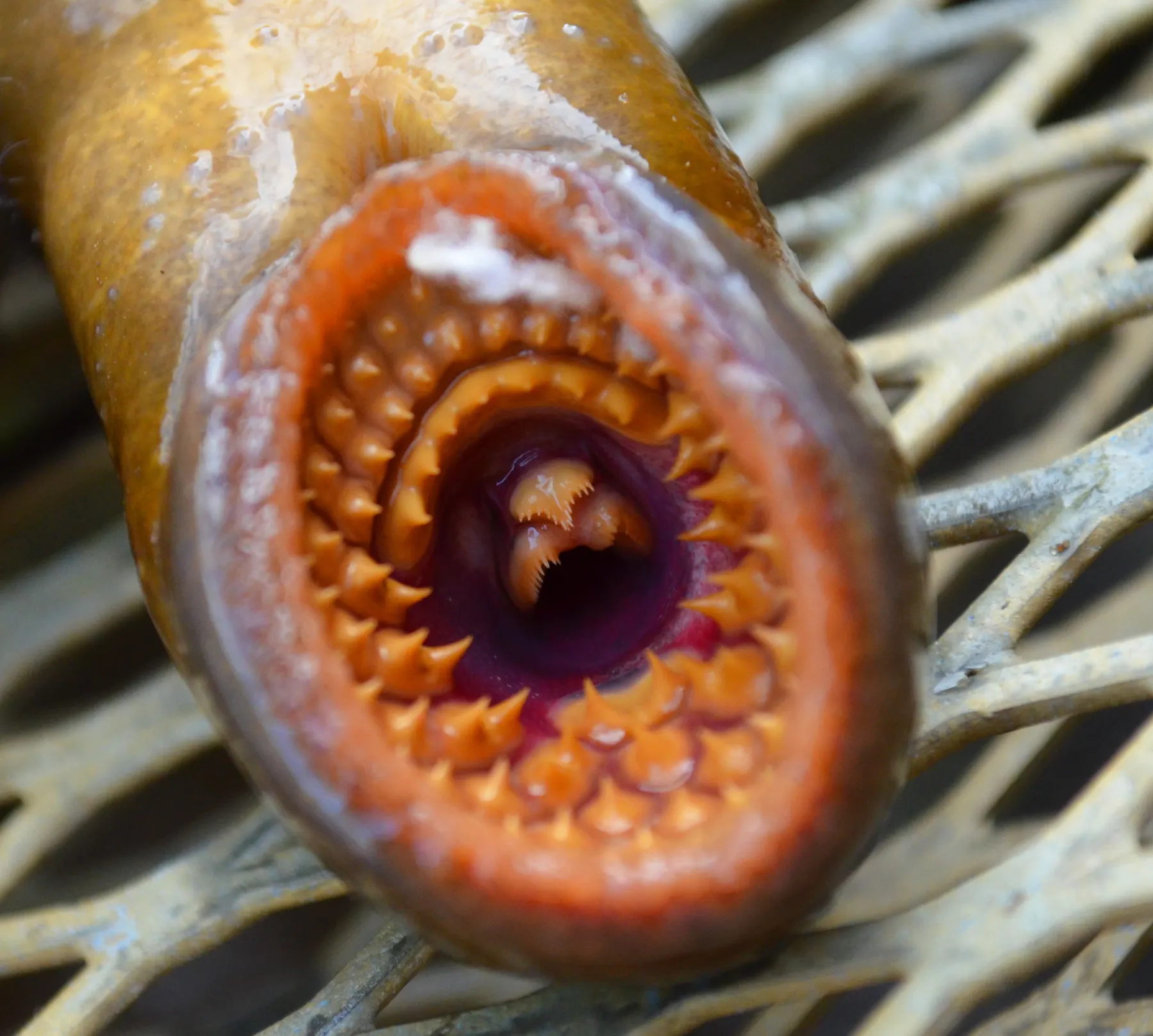
The hormonal stress axis shared by vertebrates is very old: the line leading to lampreys — jawless fish — split from ours more than 500 million years ago, and lampreys still run a version of it. Hormones buy minutes. The fossils of hominins who lived on for years after crushing injuries are consistent with something else: other people.
500million years
at least this long vertebrates have carried the same hormonal stress axis
Dates follow the published literature; where it disagrees, the range is given.
What the evidence says
Five findings
- 01The hormonal stress axis predates jaws. Sea lampreys, whose line split from ours more than 500 million years ago, run the same hypothalamus–pituitary–interrenal pattern (the interrenal is the fish counterpart of the adrenal) with a different steroid, 11-deoxycortisol. In stressed lamprey larvae it rose about fifteen-fold within six hours, and blood sugar about three-fold.
- 02“Fight or flight” is not one circuit but three, running at different speeds: adrenaline in seconds, cortisol over minutes to hours, and a separate pain-suppressing pathway in between.
- 03Henry Beecher found that badly wounded soldiers asked for narcotics far less often than civilians with comparable surgical wounds — about 32% against 83%. The size of the wound was not what set the pain.
- 04The same descending pathway can turn pain down or up. Acute stress tends to suppress pain; prolonged stress tends to do the opposite and raise pain sensitivity.
- 05Shanidar 1 lived to roughly 40–50 with a crushed left eye socket, one deaf ear, an arm lost above the elbow and a damaged leg. Hormones explain the first minutes. Years of that are consistent with a group that did not abandon him.
The scale
What does 500 million years even mean?
Large numbers do not land. So compress the whole age of the Earth into a single 24-hour day: the planet forms at midnight, and right now it is midnight again. Then zoom in, one magnification at a time, and watch our entire species shrink to a rounding error.
The spiral of deep time
Wind the whole of Earth's history into a rising spiral, and space it so that every step up is ten times closer to now. On a scale like this, the last few hundred thousand years stop being a rounding error and get as much room as the first billion.
Drag to turn the spiral. Choose an event to bring it to the front.
The spacing is logarithmic: each marked step is ten times more recent than the one below it. That is the only way 4.54 billion years and a single human life can share one picture. The flat clock below shows the same events at true proportion.
The 24-hour day
The Earth's entire history, compressed into 24 hours. One second here is about 52,500 years.
one second = 52,546 years
Another scale: one year, one millimetre
Lay time out as a road instead. Every year that passes is one millimetre of walking.
- One human life80 years8 cmabout the length of a finger
- Writing is invented5,300 years5.3 mthe length of a room
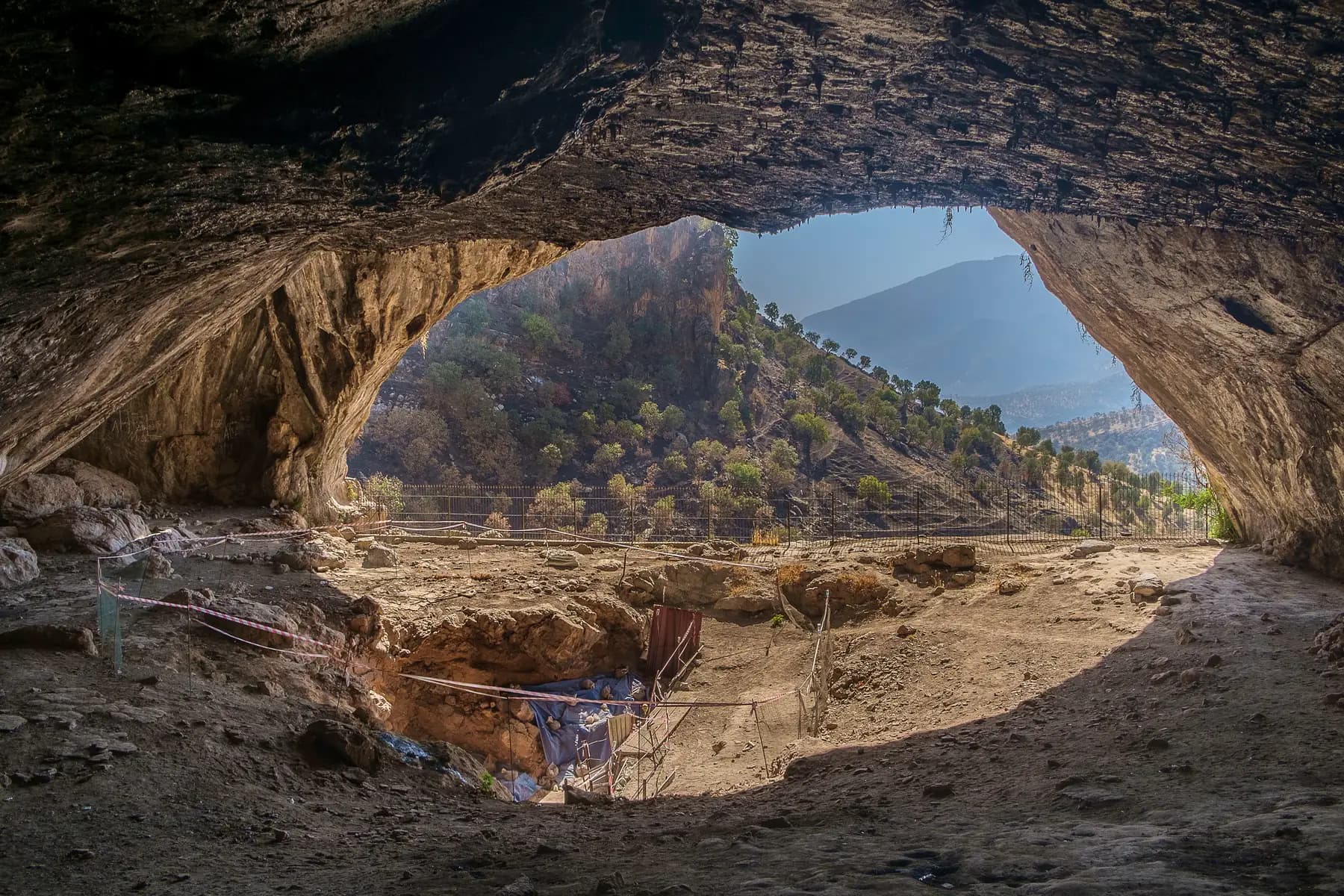
- Shanidar 1, “Nandy”50,000 years50 mhalf a football pitch
- Earliest Homo sapiens fossils315,000 years315 mabout three football pitches end to end
- Dmanisi, Georgia1.77 million years1.77 kma twenty-minute walk
- The lamprey line splits from ours500 million years500 kmabout Toronto to Montreal as the crow flies
Bar lengths are logarithmic; on a linear scale, 8 cm beside 500 km would not be visible.
Walk out of your front door in Toronto heading for Montreal, and the Shanidar Neanderthal is 50 metres behind you. The stress system he was using was built somewhere near Montreal.
The mechanism
Three circuits, not one
What we call “fight or flight” — Walter Cannon described it in 1915 as “the necessities of fighting or flight” — is several systems firing at once at different speeds. Keeping them apart matters, because the deep-time evidence applies to only one of them.
The fast circuit: adrenaline · seconds
- Threat
- Amygdala
- Hypothalamus
- Sympathetic nerve
- Adrenal medulla
- Adrenaline
Heart rate and blood pressure rise, sugar is released into the blood, pupils widen and attention narrows.
The slow circuit: cortisol · minutes to hours
- Hypothalamus · CRH
- Pituitary · ACTH
- Adrenal cortex
- Cortisol
Supplies the energy to keep going and holds inflammation down.
This is where the deep-time evidence sits. The sea lamprey runs the same axis with a different steroid, 11-deoxycortisol. In stressed larvae it rose about fifteen-fold within six hours and blood sugar about three-fold. The axis is conserved; the hormone is not.
The pain-suppressing circuit · minutes
- Fear or severe stress
- Periaqueductal grey
- Rostral ventromedial medulla
- Spinal dorsal horn
- Pain signal falls
Carried by the body's own opioids and endocannabinoids, with monoamine, GABA and glutamate systems involved too. The effect has a name: stress-induced analgesia. The same pathway can also turn pain up.
The modern human
Analgesia on the battlefield
In the Second World War, an anaesthetist named Henry Beecher studied 215 badly wounded soldiers on the Italian front, Anzio among them; most said their pain was not bad enough to want anything for it. A decade later he put the question to civilians with comparable surgical wounds and compared the two: do you want a narcotic for the pain?
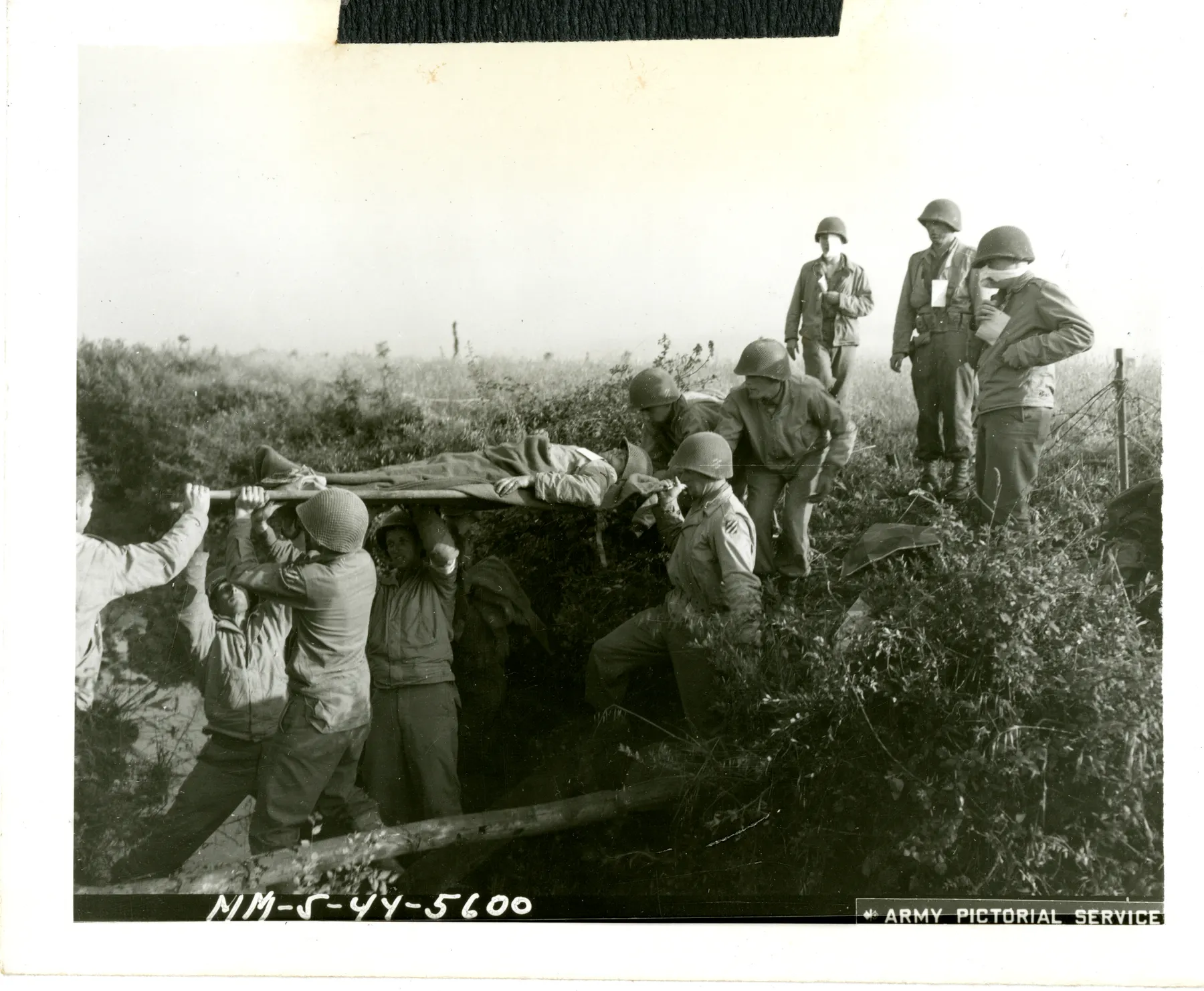
Beecher's reading: pain is not simply the size of the wound. What the situation means changes it. For the soldier, the wound meant survival and a ticket away from the front.
Two caveats popular retellings drop. The study was observational and unblinded, and the groups were not matched in advance, so treat the numbers as striking, not precise. And the effect is short-lived: prolonged, chronic stress often works the other way and makes people more sensitive to pain. The mechanism is built for the critical few minutes, not for a life lived under pressure.
The fossil evidence
Bones that healed
Healed bone means the individual lived on — weeks, months, sometimes years — after the injury. Four of them, oldest first.
- 1.77 million yearsDmanisi, Georgiaon the 24-hour clock · 23:59:26.3
The toothless individual
All the teeth but one were lost years before death, and the sockets had fully closed over. Without effective chewing, someone may have been providing soft or prepared food. It is the oldest candidate for care in our lineage — and only a candidate: the original authors also allowed that the individual could have survived unaided on soft plants and marrow, and a wild toothless bonobo has since been seen surviving long-term on its own.
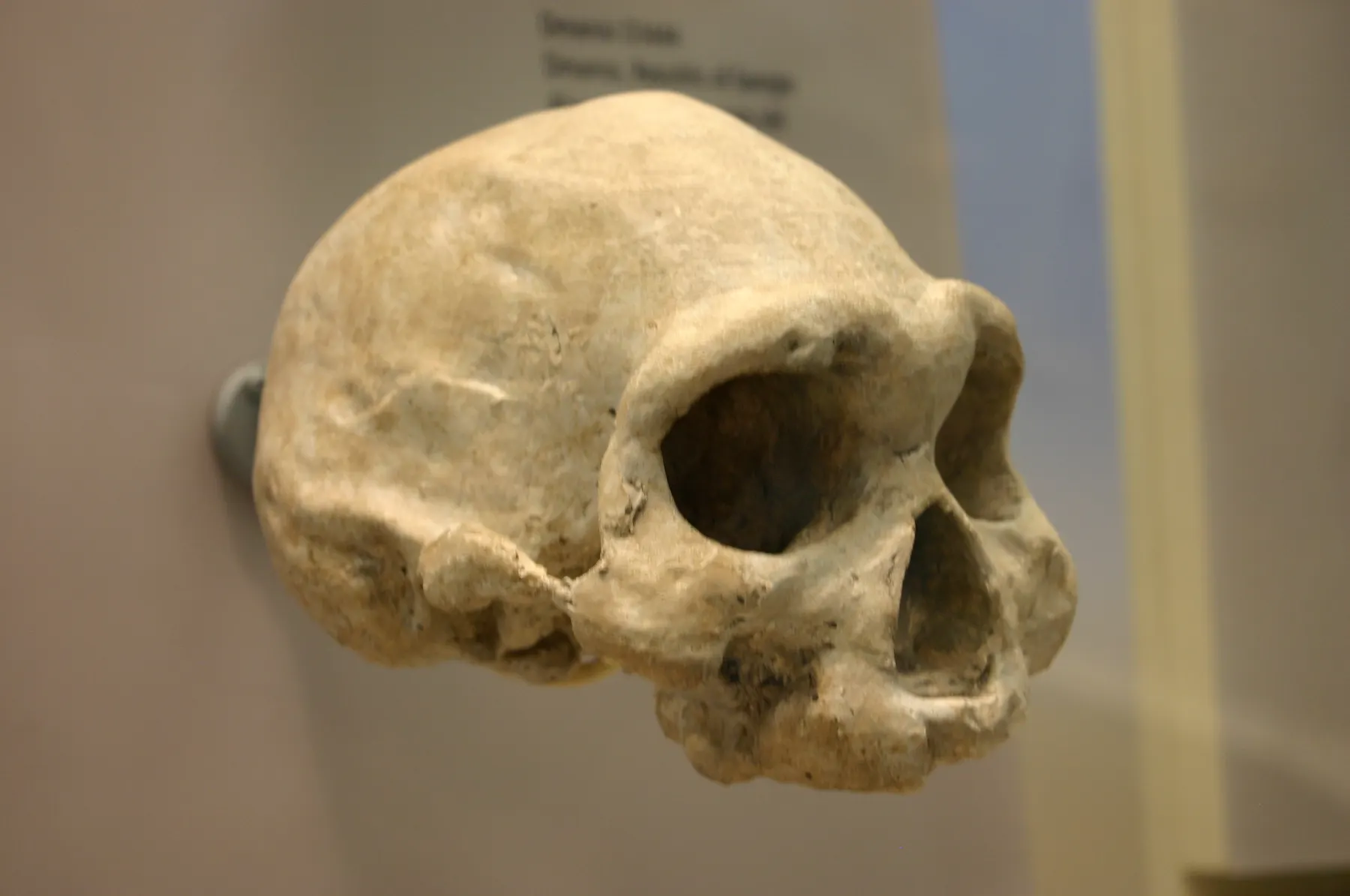
D3444, the toothless Dmanisi skull (museum cast). The tooth sockets had closed over long before death.Image credit: Ryan Somma (resized) · CC BY-SA 2.0 · Wikimedia Commons - 130–230 thousandMaba, southern Chinaon the 24-hour clock · 23:59:56.6
A healed dent in the skull
A crescent-shaped depression about 1.4 centimetres long on the right forehead, with healed margins — blunt-force trauma, possibly delivered by another hominin, though the cause cannot be known. The individual survived it. The date is unresolved: somewhere between about 130,000 and 230,000 years.
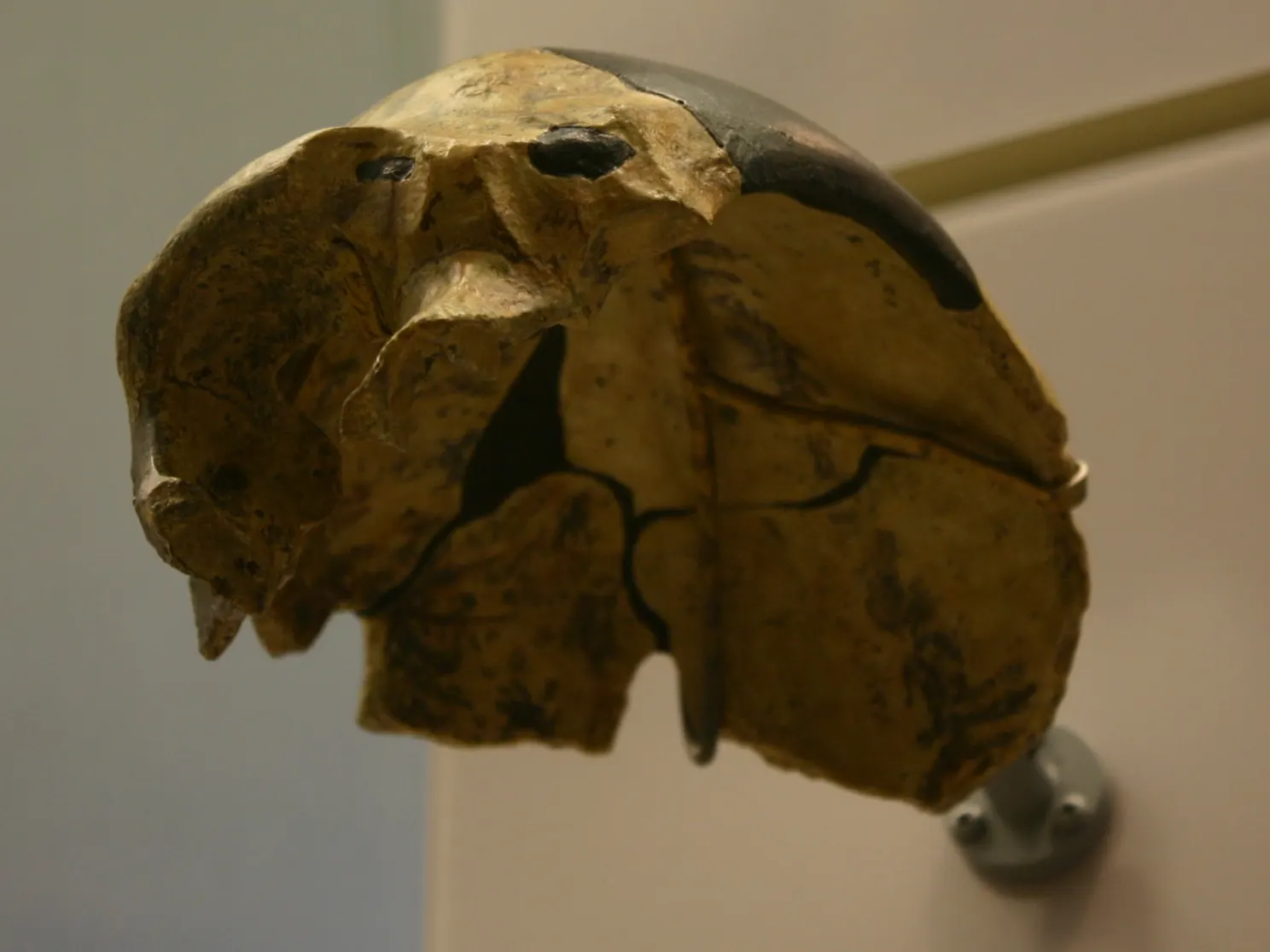
The Maba skullcap (museum cast). The healed dent sits on the right side of the forehead.Image credit: Ryan Somma (resized) · CC BY-SA 2.0 · Wikimedia Commons - 90–100 thousandQafzeh Cave, Lower Galilee, near Nazarethon the 24-hour clock · 23:59:58.2
The injured teenager
A Homo sapiens of twelve or thirteen, about 90,000–100,000 years ago, with a healed depressed fracture of the right forehead that very probably caused personality and neurological problems. Two deer antlers lay on the chest, read as a funerary offering. Injury, survival and deliberate burial in a single individual.
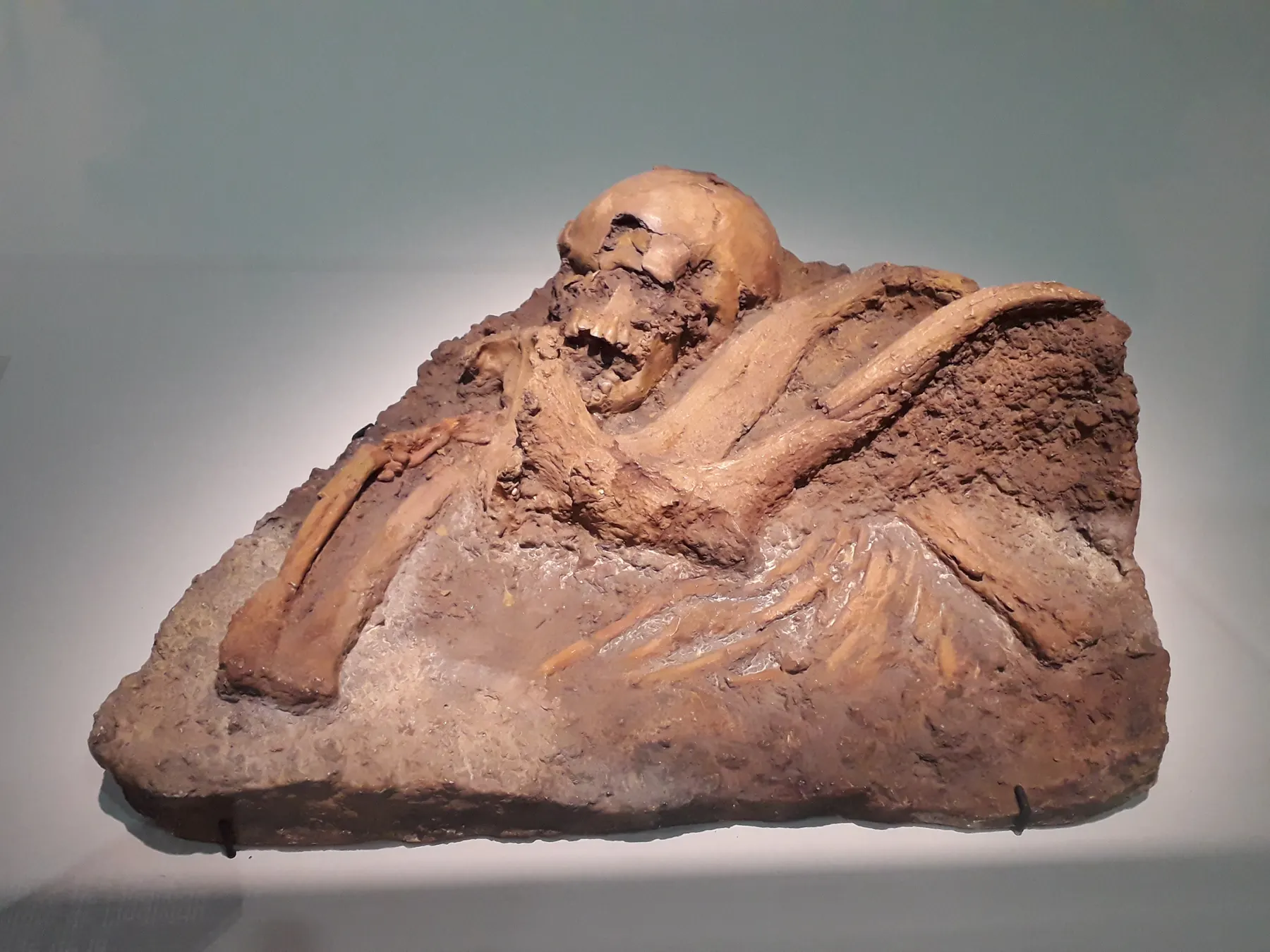
Cast of the Qafzeh 11 burial, with the deer antlers in place. Qafzeh 11 was Homo sapiens.Image credit: Eunostos (resized) · CC BY-SA 4.0 · Wikimedia Commons - 55–45 thousandShanidar Cave, Iraqi Kurdistanon the 24-hour clock · 23:59:59.05
Shanidar 1, “Nandy”
A Neanderthal who reached roughly 40 to 50 — old age for a Neanderthal — carrying a set of injuries that would be severe today. Excavated by Ralph Solecki in 1957; recent re-excavation dates him to about 55,000–45,000 years ago. See below.
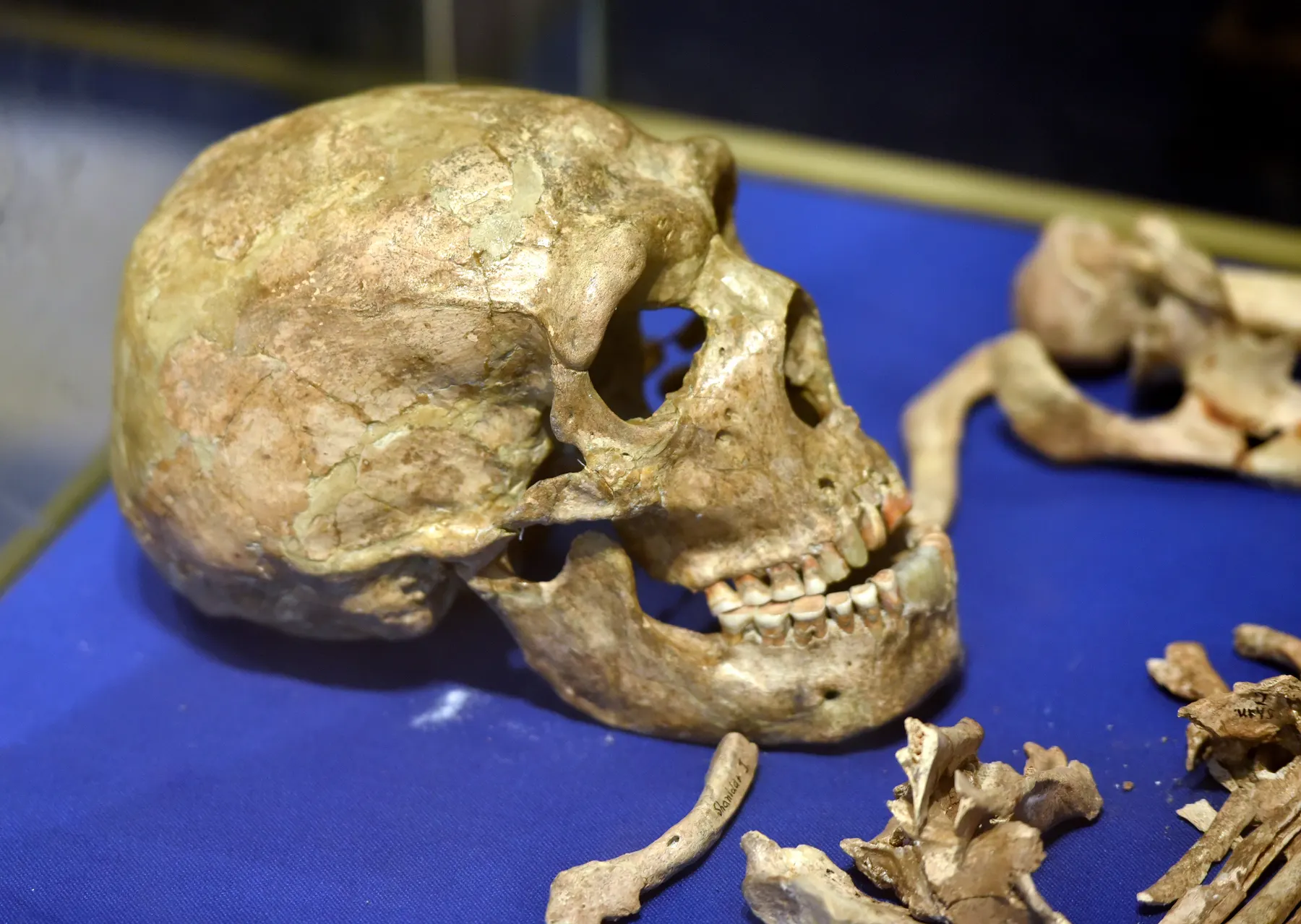
Shanidar 1's skull and skeleton, Iraq Museum, Baghdad. Note the damage around the left eye socket.Image credit: Osama Shukir Muhammed Amin FRCP(Glasg) (resized) · CC BY-SA 4.0 · Wikimedia Commons
One individual
Shanidar 1
Of all the fossils in this report, this is the one that makes the argument. Not because of what his hormones did in the first minutes, but because of what the next few decades required.
Bony growths in both ear canals; on the right they bridge across the opening. Erik Trinkaus recorded them in the late 1970s, but their effect on hearing was only assessed in 2017: he was probably effectively deaf on the right, with at least partial loss on the left. On a landscape with predators, someone who cannot hear depends on others hearing for him.
The diagram is schematic, not a reconstruction of the skeleton. What caused the injuries is unknown — a hunting accident and violence are both possible — and so is the order in which they happened.
Reading it honestly
What bone says, and what it does not
Can be said with confidence
- The hormonal stress axis is shared across vertebrates, from fish to humans, and is very old — though the hormone it runs on differs between lineages.
- Stress-induced analgesia is well documented in mammals, and opioid systems are present across vertebrates.
- Ancient hominins survived very severe injuries, in some cases for years.
Cannot be read from a fossil
- Whether Nandy had adrenaline in his blood at the moment of the blow, or whether his pain was suppressed. Hormones do not fossilise. That part is inference from living biology, not evidence from the bone.
- Whether he was cared for. Fight or flight may have carried him through the first minutes; surviving years with one arm, one damaged eye and one deaf ear is consistent with a group that kept him — not proof of it. Every case in this report is debated on exactly this point.
The body postpones pain for a few critical minutes; that is an inheritance shared across vertebrates. Hormones buy minutes, and healing takes years. The bones that healed are consistent with the thing hormones cannot supply: people who did not leave the injured behind.
Method and sources
How this was put together
- The 24-hour clock uses 4.54 billion years for the age of the Earth. Every time on it is computed from that figure, not placed by eye.
- Where a date is contested — Maba in particular, and the Shanidar layers — the text gives the range; the clock, the ruler and the spiral need one point, so they use a value inside it.
- Divergence dates are estimates. The 500-million-year figure is a floor for the split between the line leading to lampreys and ours, not the age of lampreys themselves; published estimates run from about 500 to over 560 million years. Human–chimpanzee estimates run from about 6.5 to 10 million years, some as far as 13; the clock uses 7.
- Whether the lamprey system shows the ancestral vertebrate state is itself argued over (Thornton & Carroll 2011, with a reply from Close and colleagues).
- Hormones and soft tissue do not fossilise. Every statement about what an ancient individual felt is inference from living species, and is marked as such.
- This is a summary for general readers, written from the published literature. It is not a clinical or academic source, and nothing here is medical advice.
Sources
- Close DA et al. (2010). 11-Deoxycortisol is a corticosteroid hormone in the lamprey. PNAS 107(31)
- Shaughnessy CA, McCormick SD (2021). 11-Deoxycortisol is a stress responsive and gluconeogenic hormone in a jawless vertebrate, the sea lamprey. J Exp Biol 224(11)
- Thornton JW, Carroll SM (2011). Lamprey endocrinology is not ancestral. PNAS 108(2)
- Close DA et al. (2011). Reply to Thornton and Carroll: Lamprey endocrinology. PNAS 108(2)
- Beecher HK (1946). Pain in men wounded in battle. Annals of Surgery 123(1)
- Beecher HK (1956). Relationship of significance of wound to pain experienced. JAMA 161(17)
- Butler RK, Finn DP (2009). Stress-induced analgesia. Progress in Neurobiology 88(3)
- Jennings EM et al. (2014). Stress-induced hyperalgesia. Progress in Neurobiology 121
- Trinkaus E, Villotte S (2017). External auditory exostoses and hearing loss in the Shanidar 1 Neandertal. PLOS ONE 12(10)
- Wu X-J et al. (2011). Antemortem trauma and survival in the late Middle Pleistocene human cranium from Maba. PNAS 108(49)
- Coqueugniot H et al. (2014). Earliest cranio-encephalic trauma from the Levantine Middle Palaeolithic. PLOS ONE 9(7)
- Lordkipanidze D et al. (2005). The earliest toothless hominin skull. Nature 434
- Surbeck M et al. (2020). A toothless bonobo skull challenges the notion of alternative subsistence strategies in early Homo. J Hum Evol 147
- Richter D et al. (2017). The age of the hominin fossils from Jebel Irhoud, Morocco. Nature 546
- Hublin J-J et al. (2017). New fossils from Jebel Irhoud, Morocco. Nature 546
- International Commission on Stratigraphy. International Chronostratigraphic Chart